Health and Safety Policy for Landscaping Fitzrovia
 This health and safety policy sets out the standards expected across all landscaping Fitzrovia activities. It applies to planned maintenance, soft landscaping, planting, turf care, pruning, soil handling, waste movement, and the use of hand tools or powered equipment. The purpose is to protect workers, clients, visitors, and members of the public by reducing risk and promoting safe working practices. We are committed to maintaining a safe, tidy, and controlled working environment at all times.
Safety begins with preparation. Before any job starts, a suitable risk assessment must be completed to identify hazards such as moving vehicles, uneven ground, manual handling strain, falling debris, weather exposure, and contact with machinery. Where needed, method statements should explain how the work will be carried out safely. Landscaping safety is not treated as an extra step; it is part of every task from the beginning to the end.
All personnel must be competent for the work they perform and must use equipment only when trained and authorised. Tools and machinery should be inspected before use, kept in good condition, and stored correctly after use. Any defect, near miss, or unsafe condition must be reported immediately. Unsafe shortcuts are never acceptable, even when tasks are routine or time-sensitive.
General Safety Principles
Good landscaping health and safety depends on clear communication, careful planning, and consistent supervision. Work areas should be organised to reduce trip hazards, ensure safe access, and separate people from dangerous operations where practical. Signs, barriers, cones, or temporary controls may be used when the public could be exposed to risk. Where tasks create noise, dust, flying debris, or slippery surfaces, extra precautions must be taken.
Personal protective equipment, or PPE, must be selected according to the task and worn correctly. This may include safety boots, gloves, eye protection, hearing protection, high-visibility clothing, and weather-appropriate clothing. PPE does not remove the need for safe methods, but it provides an essential additional layer of protection. All workers are expected to keep their PPE clean, serviceable, and suitable for the work being done.
 Manual handling is a common hazard in landscape maintenance and planting work. Heavy bags, plants, tools, pots, and materials must be moved using proper lifting techniques and, where possible, mechanical aids or team lifting. Loads should be assessed before lifting, and workers should avoid twisting, overstretching, or lifting beyond their capability. If a load is too heavy or awkward, it must be handled differently rather than forcefully.
Worksite Controls and Environmental Care
 At the middle of any landscaping operation, attention must remain on changing conditions. Weather can affect ground stability, visibility, and worker fatigue. Heat, cold, rain, and wind all create additional risks, so work plans should be adjusted when conditions become unsafe. Hydration, rest breaks, and appropriate clothing are important for maintaining safe performance throughout the day.
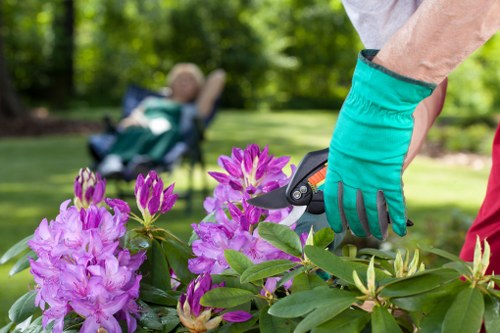
Planting, pruning, and site clearance tasks must be carried out with care to protect both people and existing features. Sharp tools should be handled responsibly, blades should be covered when not in use, and all cutting actions should be controlled. Branches, stones, green waste, and other materials must be cleared promptly to keep access routes safe. Where work involves soil disturbance, attention should be given to buried hazards, services, and unexpected obstructions.
Environmental responsibility is also part of this policy. Waste should be separated where practical, green material should be managed responsibly, and fuel, oils, or chemicals must be stored and used in a way that prevents leaks and contamination. Water use should be controlled, and equipment should be operated efficiently to reduce unnecessary impact. A safe site is also a well-managed and environmentally mindful one.
Equipment, Chemicals, and Emergency Response
Powered equipment used in Fitzrovia landscaping work, including hedge trimmers, mowers, blowers, and saws, must only be operated by trained users. Guards, switches, cables, batteries, and fuel systems should be checked before use. Equipment must never be left running unattended, and refuelling or charging must follow safe procedures. Any machine that behaves unusually or shows signs of wear should be removed from service until inspected.
Chemicals, fertilisers, and treatments must be selected and applied in line with safe handling instructions. Containers must be labelled, stored securely, and kept away from unauthorised access. Spill control measures should be available when required, and workers must avoid contamination of watercourses, drainage systems, and adjacent surfaces. If any product exposure occurs, the affected person must receive immediate first aid and follow the correct emergency steps.
All staff must know the basic emergency procedure for incidents, injuries, fire, or environmental release. First aid supplies should be accessible, and at least one competent person should be available where required by the task or team size. In an emergency, the priority is to make the area safe, alert others, and seek help without delay. A clear report should follow once the immediate danger has passed.
Responsibilities and Compliance
 Before one of the last stages of any job, supervisors must review whether conditions remain safe and whether controls are still effective. Workers are responsible for following instructions, using equipment correctly, wearing the required PPE, and speaking up when something feels unsafe. Supervisors are responsible for planning work, providing suitable resources, and monitoring performance. Good safety management depends on everyone doing their part.
Training and refresher sessions should be provided where needed so that workers remain confident in safe methods, hazard awareness, and emergency action. Records should be kept for inspections, incidents, corrective actions, and any relevant assessments. Regular review helps improve standards and ensures that this policy stays practical and effective. Continuous improvement is expected, not optional.
Failure to follow this policy may lead to corrective action, removal from a task, or further review of working practices. More importantly, unsafe behaviour can put people and property at risk. By following this policy, landscaping Fitzrovia teams can deliver reliable work while protecting everyone involved and maintaining the highest reasonable standards of care.
 This policy is intended to support safe, responsible, and professional landscaping work in every season. Whether the task involves planting, maintenance, clearance, or the use of specialist tools, safety must remain central. A careful approach protects workers, supports quality results, and helps ensure that all landscaping services are delivered with confidence and control.